3D Animation Essentials
Understanding Modeling and Texturing
Displaying and finishing are two of the essential positions
inside the field of 3D activity and are intently attached to each other.
Demonstrating is the demonstration of making a 3D item. Finishing is applying
the variety and surface properties to the model. Each industry that utilizes 3D
movement should begin with the making of a model, which then, at that point,
fills in as the establishment for the wide range of various strides in the
creation pipeline. Finishing is the stage after a model is made, and the use of
the surface relies upon the math type used to
make the model. By taking a gander at every calculation type
and work process independently, you can see the benefits and inconveniences of
each and consequently better figure out which type to utilize. In this section,
you will likewise take a gander at a portion of the standard material sorts and
surface guides that surface craftsmen use to make the vibe of the last model.
• Demonstrating
• Finishing
Demonstrating
Demonstrating is a fundamental piece of 3D liveliness. All
that you find in any 3D movement must be made (digitized) somehow. Regularly, a
model is either made without any preparation or depends on a 3D output or other
type of digitization that is then tidied up.
Modeler is the work title of a craftsman who makes or tidies
up the calculation of a 3D model. You can consider 3D movement modelers
computerized artists. Displaying is additionally commonly the beginning spot
for fledglings to gain proficiency with their strategy for getting around 3D
programming, since demonstrating expects you to move around an item, control
and right parts of articles, and work with different.
qualities and properties of the 3D programming. Nonetheless,
on the grounds that displaying is a beginning spot for 3D illustrators to get
comfortable with the product doesn't make it simple to dominate. It requires
long stretches of training to consummate a displaying work process, make models
with effective and legitimate goal, gain a comprehension of how actual items
work and are assembled, and grasp human life systems prior to turning into a
capable and proficient modeler.
A great many people in 3D liveliness either love or disdain
displaying, in light of the fact that the specialized constraints of the
product can cause the errand to feel unnatural to starting 3D craftsmen. Models
made in 3D programming, for example, Autodesk Maya, 3ds Max, and Softimage
expect craftsmen to move individual parts (in certain occasions, each in turn),
which is definitely not a characteristic displaying experience. New
programming, including Pixologic's ZBrush and Autodesk Mudbox, has consolidated
form with the goal that craftsmen can function as though moving around dirt.
This change has further developed displaying work processes and improved the
degree of conclusive detail in the models.
A modeler can utilize three calculation types to make models:
polygons, nonuniform objective B-splines (NURBS), and region surfaces. These
calculation types are the numerical portrayals of a 3D structure. Each enjoys
its benefits and detriments and part level contrasts.
Polygons

Separating
While separating a polygon, you make another edge across its
face, as displayed in Figure Partitioning can occur across a solitary polygon
or around a whole polygon object. Partitioning a whole polygon object is
frequently alluded to as adding an edge circle — a bunch of associated edges
across a polygon surface that meet back at the principal edge to make a circle.
An edge circle is one of the most well-known ways of making more math goal in a
model, which considers more detail. An edge circle gives the most effective
method for partitioning the calculation of a polygon object in light of the
fact that the client characterizes where the region or extra math will be set.
The manner in which edges stream along a model is called edge
stream. Great edge stream is coordinated and commonly follows the state of the
item or the muscle life systems of an animal. Great edge stream supports the
twisting of the model later, in the gear cycle. Figure 5.4 shows the edge
stream of a human head. The edges stream in roundabout examples around the eyes
and mouth, which imitates the strong construction of the face.

Adding an edge
circle to a polygon chamber
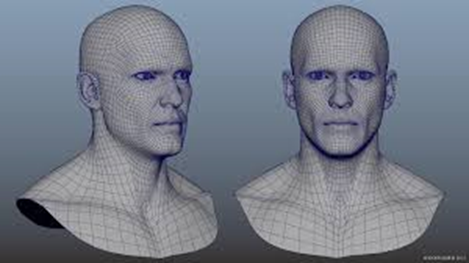
Edge
stream of a human head
Smoothing
Smoothing partitions a polygon item and midpoints the points
framed by all edges of the first math. The left picture in Figure shows a shape
that has been smoothed two times, partitioning its countenances and changing
the 3D square into a circle. Every development level midpoints the point of the
two countenances associated by an edge, and on account of the 3D square, brings
about a circle. The right picture of Figure shows this movement. The top shape
is the first 3D square that has a 90-degree point between the two unique
countenances. After a first degree of smoothing, the two face are partitioned
once, giving us four countenances, and which changes the top point edge to 45
degrees. In the second degree of smoothing, each face is partitioned once more,
and the first top edge point changes to 22.5 degrees (with the points framed by
different edges changed also).

A block smoothed to make a circle (left), and a delineation of the polygon smoothing process (right)
Finishing
Finishing is the method involved with making the surfaces and
variety credits of models to cause them to look like anything object they
should address. An individual who surfaces models is known as a surface
craftsman. Notwithstanding, at certain studios, the modeler is answerable for
finishing models.
Surface craftsmen should have a decent comprehension of what
compels an article look the manner in which it does, not with regards to its
actual shape, but rather concerning surface and variety. Surface specialists
control shader properties in the 3D programming to accomplish the ideal
outcome. For instance, an incomplete wood tabletop that is pristine isn't
intelligent yet has a slight matte sheen across its surface in light of the
fact that the wood strands are not firmly compacted. As a similar wood tabletop
ages and is utilized after some time, the wood strands become compacted, which
changes the presence of the surface by making it marginally intelligent and
gleaming.
Surface craftsmen should likewise have the option to
impersonate the variety and examples of the item they are finishing. Again utilizing
the wood tabletop model, each kind of wood has an unmistakable designed grain,
and the surface craftsman should have the option to make the right example to
put on the item. Little subtleties, for example, knowing the kind of grain to
put on a wood table are basic to surface craftsmen.
Surface specialists ought to likewise chip away at acquiring
major areas of strength for an of observational abilities to assist them with
understanding how to recount an item's story without saying a word. They need
to know where to put blemishes, scratches, soil, form, and different
imperfections that are significant in 3D movement finishing. The production of
ideal articles with wonderful surfaces is the default in 3D activity
programming, yet that flawlessness basically uncovers that an item is phony onscreen.
Making surrenders genuinely sells an item as being genuine.
Normally, surface craftsmen get a last model from the
demonstrating office and need to make an UV map for the object(s). They then,
at that point, make the shader with the right surface properties to address the
object(s). Next they hand-paint or photograph control pictures in programming,
for example, Adobe Photoshop or Autodesk Mudbox to make surface guides for the
various properties of the shader, for example, a variety guide or reflectivity
map. Surface craftsmen additionally make renderings of the item to show the
lighting group what the article ought to resemble after it is lit and
delivered. This part covers these subjects of 3D UV planning, shader
organizations, and lighting and delivering procedures.


